Sunday, October 4, 2009

A Brazilian Breakfast

The Brazilian Cafe da Manha (breakfast) you will get in guesthouses all over the country is pretty similar. There will be some bread rolls, possibly ham and cheese, and jams. Often you will have some cream crackers in addition to the bread. Maybe some sweet cakes also. There will be a container of black Brazilian coffee and another with hot milk. If you prefer there could be hot water and tea bags. A jug of home blended juice of mango, guava or something similar will be available. For sweetening there is of course sugar but also a small bottle of synthetic sweetener. Some places might offer you eggs, sunny side up or scrambled, and yoghurt.

But the best part is the fruit selection. My father adored fruit and I am my father's son so I like this part of the Brazilian breakfast. You will have a selection of tropical fruits widely consumed in Brazil: abracaxi (pineapple), mamão (papaya), melão (honeydew), rockmelon and melancia (watermelon) are common but you might sometimes get manga (mango).

Braziian breakfast coffee is plentiful and strong. It isn't particularly refined in taste but it does the job. It reminds me of the coffee you get in kopi tiam in Malaysia, which looks like it's been made with ground-up charcoal but actually has a kick. The coffee you consume after dinner is more like the expressos you are used to.

Webjet Brazil

Brazil has low-cost airlines too, like Webjet, Oceanair and Gol. So when I thought of taking the plane between Recife and Salvador instead of spending 14 hours on a bus, I can just book online with my trustworthy Linux netbook, right?


Unfortunately these airlines require a CPF to be entered. A CPF is a personal identification number every Brazilian is issued with. With Gol, only the credit card holder's CPF is required so conceivably one could persuade a Brazilian to make the purchase for you, and you reimburse her in cash. But the Webjet purchase page requires the CPF of the passenger too. What would a foreigner like me do for a CPF? Tough luck.


There's no problem however buying tickets for the mainstream airlines like TAM using Expedia, etc. But they cost more.


So I will just take the Recife metro to the airport and see if I can buy a ticket on the spot. Grr. Wish me luck.

Pirangi

Rhymes with bungee. This is about 15 km south of Ponta Negra in Natal and was originally a place I had intended to overnight in. I decided to make it a day trip from Natal. The reason I wanted to go there is that the largest caju (cashew) tree in the world lives there.

I made one abortive attempt to visit it on Friday. I learnt of the right bus service from the hostel warden and got onto it. But when the conductor came around and I said Pirangi, he rattled off something too quickly and indicated that I should get off and take the next bus. My guess is the bus was going only part of the way, to the depot or something like that, as it was full of people going home. Dispirited, I walked back and vowed to try again the next day.

This time I caught a local bus to downtown. At the terminus, the old rodoviaria, where the guidebook said the service started, the driver asked me what bus I wanted to transfer to. When I told him of the Pirangi service, he went into the office to consult with his colleagues and then told me to get on again, via the back door, to not have to pay another fee going through the turnstile. Then he took me to a stop about halfway between Ponta Negra and downtown where he said the service would pass. It turned out to be the same service as the day before, but starting from the new rodoviaria. I could have caught it from Ponta Negra and not have to go downtown. It seems things are in flux as services move to the new station. It was nice of him to take me back. So I got a tour of downtown for my bus ticket.

The caju tree is a freak. Planted in 1888, it had two mutations that caused it to grow so large. Firstly its branches spread out horizontally instead of mostly vertically. Secondly when the branches touched the ground they sprouted roots and became like trees in their own right. So the result is that one tree has turned into a veritable forest covering 8,500 square metres and still trying to grow outside the compound reserved for it. It got into the Guinness Book of Records and is a tourist attraction now. I paid R3 to visit it. The fee goes towards the maintenance of the compound and hiring people to look after the attraction. From above on a viewing platform all you see is a sea of green. From below you can wander underneath the canopy and spot the original trunk. It was in flower and not in fruit yet this time of year. It still produces some 80,000 caju fruit per year. Its fruits are given away as souvenirs to visitors.

I feel a certain respect towards this old survivor, this inhabitant of the planet who was already old when I was born and will probably outlive me.

Saturday, October 3, 2009

Natal

Natal was christened on Christmas day 1599.

If you are following me on a map, I am no longer on the top of the shoulder of Brazil, but on the side. It was quite a long trip getting here. First there was the trip back to Fortaleza in reverse. This time I got off at the rodoviaria (bus station) at about 2200, where I had 1 hour to buy a follow-on overnight bus to Natal of 8 hours. I was a bit worried the bus might be full (there were no online sales) and I would have to spend another night in Fortaleza, but no problems. By the time I got to Natal around 0730 the sun had already been up a couple of hours, so far east of the nominal timezone meridian is Natal. Correspondingly the sun goes down about 1730. I kicked myself mentally for not taking my jacket out of my backpack before it went into the luggage hold. I had forgotten how cold the air-conditioning in overnight buses are.

I first had a coffee and an "eggsburger" in the Natal rodoviaria before looking for the right bus stand for the bus to Ponta Negra (Black Point), the beachside suburb where travellers normally go. I had to ask the locals a couple of times; they were very helpful.

When I reach Ponta Negra I made a couple of mistakes by not referring to the guide book. Firstly I was under the impression that the landmark shopping centre was on the other side of the road. Secondly I thought the other landmarks on the map were before, not after my stop. As a result I took the bus to the end stop and go off when I realised it would go no further. That'll teach me. How far back to walk? Looks like 300m on the guide map. No problem. Actually it was more like 1km. Still there's only 15 minutes normal walking pace but what with the backpack and uneven pavement, it's more like 30 minutes. What doesn't kill me only makes me more tired, Nietzsche never said. So I appreciated the shower I took on reaching my dorm, all the more because the previous night had been spent in a bus.

I'm out of clean laundry and the hostel will also wash and dry my clothes, for a fee. No problems. No point travelling in uncomfortable dirty clothes; you will just feel grumpy.

Natal is cleaner than Fortaleza and there seems to be more work for the citizens. I felt ok even on the street. Everybody seemed to be busy doing their own thing and not that interested, with malice or otherwise, in a foreigner. Over the next couple of days I observed the following: Lots of western style shopping centres. More cosmopolitan; I saw Thai, Chinese, Japanese, and even Turkish restaurants. I also saw more Asian residents (they spoke Portuguese and behaved like locals). More evidence of non-Catholic faiths; I saw Assembly of God and Jehovah Witnesses halls. More evidence of foreigners living here; I saw a te koop (for sale in Dutch) sign and various condo projects aimed at upper class Brazilians and foreigners. Skyscrapers and condos abound. I suspect the middle class is larger in Natal.

Jeri is built alongside dunes, but Natal is built on them. You can see the sand showing in this photo of a part of the coast. That long slope of sand looks irresistible to slide down, but I read that there are plans to close it, as it's getting too much damage.

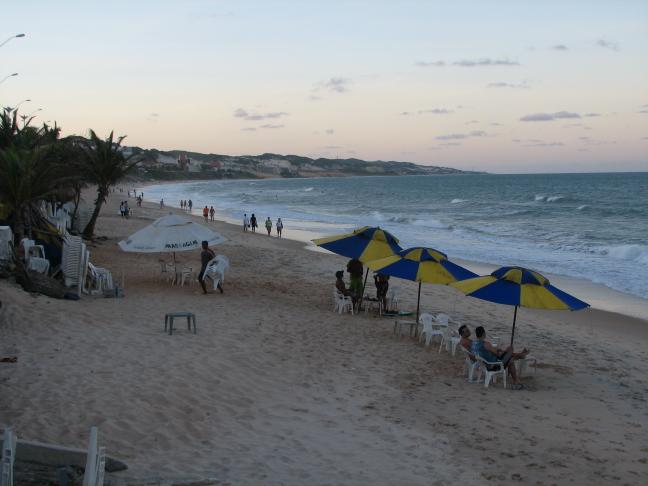
The beach and promenade of Ponta Negra are ok but not irresistible. It's also about 100m downhill from the main street. So the more expensive accommodations are much closer to the water. On the other hand, you get a good view to sea higher up. And there are constant cool breezes from the ocean which make the heat of day more bearable and are absolutely delectable at night.

I feel that I'm spending more here in Ponta Negra compared to the other beachside suburbs I have visited, due to the higher prices due to the more affluent people.

Friday, October 2, 2009

Hidden extras

One annoyance with spending in Brazil is how some extra costs are not initially apparent. For example if you eat at a restaurant there will be a 10% tax, so factor that above the prices you see on the menu. At the rodoviaria (bus station) in Fortaleza there was a R$2 charge levied by the bus station for the facilities.


Tthe locals are used to these arrangements and there is no attempt to make things friendly for visitors by quoting all-inclusive prices. We should be glad that the Australian government mandated that the tag price should be GST inclusive. Now if only they could get the cheap airlines to include all extra costs in their ads.

Thursday, October 1, 2009

Jericoacoara 2

Here are some random observations that didn't fit into the previous 2 posts on Jeri.


The last part of the trip was made, as mentioned before, in a jardineira. This left the main road and took a dirt track towards Jeri via a beach. This was a truly bumpy ride with the vehicle going up and down depressions, fording one or two small streams, sometimes having to shift to the lowest gear to get through particularly slippery sands, and so on. It takes over an hour to cover the 24 km or so.


At the start of the dirt track, there are caju trees on both sides. I also saw the occasional mango tree. The plantations didn't look particularly well looked after, or maybe the caju tree requires less husbandry than I think. The tree is native to this region. It's a strange fruit to behold. The Wikipedia explains that what looks like the fruit is actually a false fruit that develops from the receptacle of the true fruit, the drupe holding the seed which we call the cashew nut. The drupe looks like an afterthought to the large false fruit, like something that might drop off easily but I picked up a fallen fruit and could not easily separate them by hand. The false fruit is edible and can be turned into a drink but is too easily bruised to transport. I should try a caju drink sometime.


As mentioned, people come to Jeri to chill out and a host of local businesses have developed to cater to tourists. Beside the regular bus+jardineira combination, it is also possible to get there by 4x4 over the coast. Besides the restaurants, drinking holes, patisseries, ice-creameries, and Internet cafes, there are buggy operators, sports outing operators, beauty services, artisans and so forth. However it seems to be low season now and the owners are grateful of any business. They all seem to be small operators, nobody has resort-ified Jeri, and I hope they never do. However it means that the businesses are a bit haphazard. At the restaurant where I ate my second night's dinner, the musician was a guitar player and vocalist. But he sounded a bit out of tune and I doubt if he will be releasing any albums.


The villages on the dirt track are typical rural Ceara. There will be a main street usually the same one you came in on, a couple of side streets, and a main square with a church or town hall. There will be a bakery, a grocer, maybe a mobile phone shop, a mechanic workshop, a beautician, and sometimes a clinic. You can probably get videos from the general store. There will be people sitting on porches as you go past. Some children will be playing in the street. Maybe some school kids will be coming back from school. Yards may have chickens scratching around for food. These people are not isolated from the outside world, they have their phones and watch the same TV programs as the Brazilians in the city. But their work will be to do with local agriculture or serving people who work in it. I suspect the young will try to get out and go to school in larger towns or even big cities, coming back by the bus service for holidays. I hope they will get better schooling than the bugeiro who could not write my name properly as I spelled it out for him, reversing the N. Brazil has a large population, around 200 million, and much of it is young. Their education will determine the progress of the nation.


The dunes surrounding Jeri are unique but it's also a long way to travel, over 7 hours each way from Fortaleza. Was is worth it? Yes, but probably only once. Perhaps it's this isolation that keeps Jeri from getting too commercial.

I don't wanna boogie

(In the last episode our intrepid traveller arrived in Jeri and is trying to decide whether to take a guided tour of the famous Jeri dunes and a dozen other attractions, as promised in glossy photos on the bugiero ad poster.)

The bed has a mosquito net above it and I take this as a hint that it is needed. Inspite of that a few pesky mossies slip through and reduce my sleep.

In the morning I come to a decision. I don't really want to be taking tours all the time. I'm a bit tired from lack of sleep and another tour would burn me out. Also my wallet a bit. There are apparently some sights within walking distance. I can go sightseeing in the morning and in the afternoon when it is cooler. When the bugiero comes around, I tell him thanks, but no thanks.

I walk out of the pousada and there it is, a dune. I didn't see it in the dark last night. Not the dune, but a dune, one of the many dunes in the area. Great, take some pictures now and also later, in the evening, when the light is also good. Unfortunately dunes look best in panoramic shots and I don't have any.

In the meantime, I can have a dip in the pool before lunch, lie on a hammock and listen to music. So there I was, listening to Jobim's Amar Em Paz (Once I Loved) on the MP3 player, with the gentle rustle of coconut fronds in the background and a cool breeze flowing through. It doesn't get much better than this.

Later, in the evening, I find that people walk up the gentle slope, pee on a pole in a re-enactment of an ancient Indian ceremony, then slide down the steep slope. Sorry, I made up the part about the pole. Walking up isn't as easy as it looks, you don't get as much purchase on sand. So I didn't climb it. Also to be honest, while it's nice to see dunes from higher vantage point, a dune is a dune. Been there, dune that. Sorry. What I mean is the dune itself has only shape, and it's the light and clouds that paint colour and shadows on it. I think the ideal way to see them would be from a light aircraft, hot-air balloon, paraglider or similar. And if one were very keen, one could take a series of photos of dunes in every light and season. Sort of like that postcard with a mosaic of pictures of the Matterhorn in various lights. But I'll have to content myself with ground level photos and viewing other people's pictures.